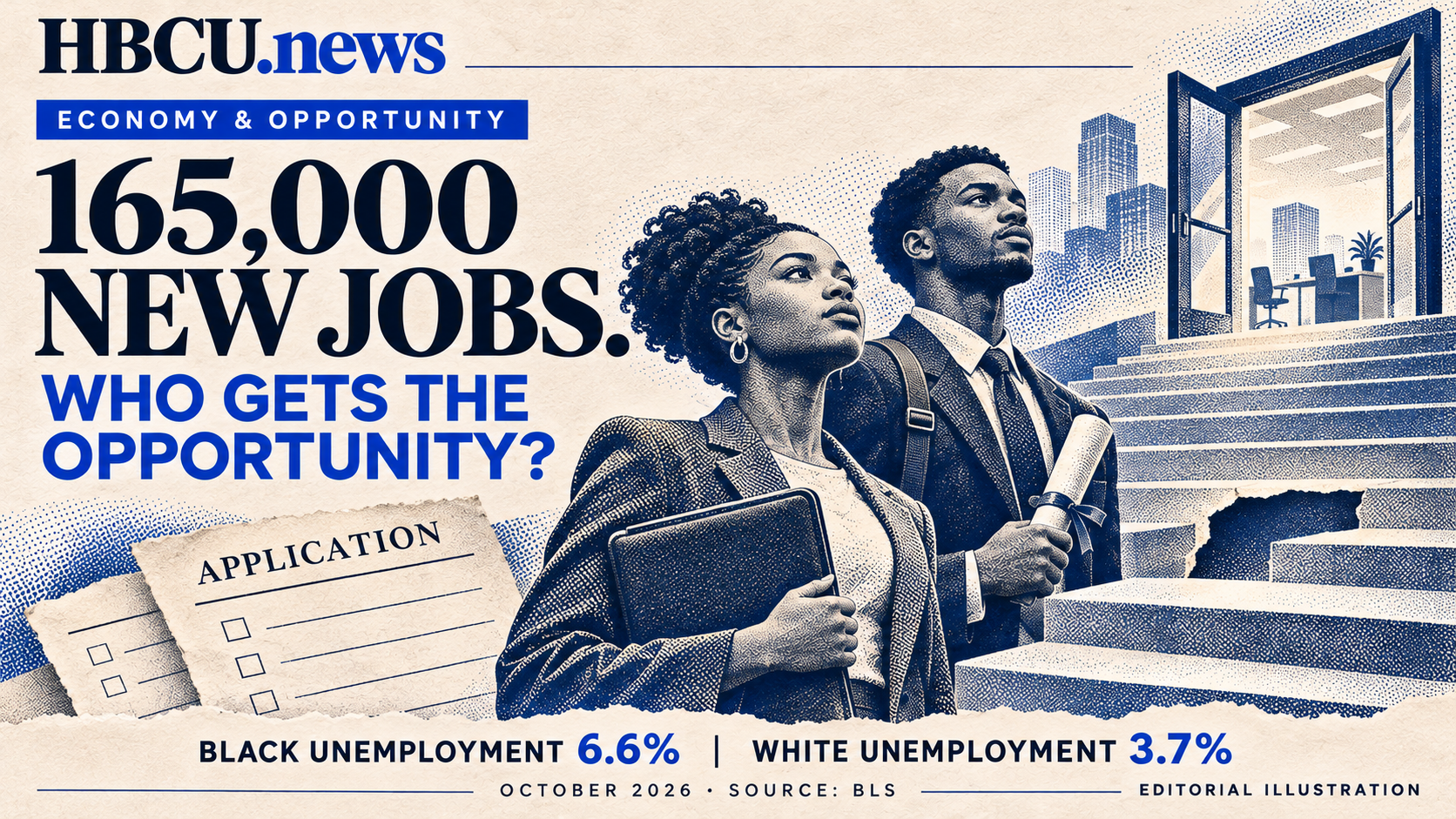
America added 165,000 jobs in October. For millions of Americans, that sounds like good economic news.
But another number deserves just as much attention.
Black unemployment stood at 6.6%, compared with 3.7% for White workers.
According to the U.S. Bureau of Labor Statistics' November 6 report, the national unemployment rate was 4.1% in October. Black unemployment was approximately 1.8 times the White rate. These are seasonally adjusted estimates for people age 16 and older in the civilian noninstitutional population.
For historically Black colleges and universities, their graduates, and the communities they serve, the difference raises an important question: What does a growing economy mean when access to employment remains so uneven?
The numbers behind the headline
The difference between 6.6% and 3.7% is 2.9 percentage points.
Put another way, among every 1,000 Black people participating in the labor force, approximately 66 were unemployed. Among every 1,000 White labor-force participants, approximately 37 were unemployed. Those are illustrations of the reported rates, not counts from a group of 1,000 survey respondents.
BLS counts people as unemployed if they are jobless, have actively sought work during the preceding four weeks, and are available for work, with an exception to the search requirement for people expecting recall from temporary layoff. The figures do not include everyone without a job.
The payroll gain and unemployment rates also come from different surveys: employers report payroll jobs, while a household survey measures people's employment status. AP's Paul Wiseman and Reuters reporting independently corroborated the 165,000-job gain and 4.1% national unemployment rate on November 6.
But the national unemployment rate alone doesn't tell the entire story.
Black unemployment fell. So did Black employment.
October's unemployment report contains another important distinction.
The Black unemployment estimate declined from 7.0% in September to 6.6% in October. BLS characterized changes across the major demographic groups as little or no change, so that numerical decline should not be read as a definitive improvement.
Yet the estimated number of employed Black Americans also fell by approximately 56,000, from 20.660 million to 20.604 million, according to the report's seasonally adjusted Table A-2.
At the same time, the estimated Black labor force declined by approximately 161,000, from 22.212 million to 22.051 million.
How can unemployment fall while employment also declines?
The unemployment rate measures unemployed people as a percentage of the labor force. When the number counted as unemployed falls proportionately more than the labor force, the rate can fall even without an increase in employment.
These are net changes in survey estimates, not a count of identified individuals leaving work or stopping their job searches. The figures do not establish why participation changed. Education, caregiving, retirement, and stopping a job search are possible reasons people may be outside the labor force, not findings about what happened to these particular workers.
Monthly labor-market estimates also fluctuate, making longer-term trends essential.
A falling unemployment rate does not automatically mean more people found jobs.
What the gap means for Black communities
Employment is about more than a paycheck.
For households, consistent work helps create the financial stability necessary to pay bills, build emergency savings, support children through college, and eventually invest in assets such as homes and businesses.
Job loss or a prolonged job search can interrupt those plans.
The consequences can extend beyond individual households. When families have less money available to spend, businesses that depend on local customers can also feel the effects.
A research paper published by the Federal Reserve Bank of Minneapolis, examining four decades of labor-market outcomes, found persistently higher Black unemployment and a greater risk of job loss. It found that observable characteristics, including education, explained little of the Black-White unemployment difference. That historical finding provides context; it does not identify the cause of October's gap.
That research helps explain why national economic growth does not necessarily translate into the same level of employment security for every community.
However, the October jobs report does not measure these household and neighborhood consequences directly.
What does this mean for HBCU graduates?
For students preparing to enter the workforce, the report presents both opportunities and unanswered questions.
Professional and business services added approximately 70,000 jobs in October, while health care and transportation and warehousing also experienced growth, according to BLS.
But industry-wide hiring does not tell us how many positions are available to recent graduates—or how effectively employers are recruiting from HBCUs.
The federal report does not separately identify employment outcomes for HBCU graduates.
That information needs to come from university career centers, graduate employment surveys, employers, and students themselves.
Are companies expanding their recruitment at HBCUs? Are students securing internships that lead to full-time positions? And are graduates finding work in their chosen fields?
Those questions deserve reporting of their own.
The bigger picture
October's jobs report shows that the United States continued adding jobs. It also shows that significant racial differences in unemployment remain.
Both facts can be true.
For students, the practical next step is to look beyond national headlines: examine local job markets, connect with career services, research employers recruiting in growing industries, and evaluate opportunities based on compensation and long-term prospects.
For HBCU.news, the larger question remains:
If the economy is growing, how do we measure whether that growth is creating opportunity across the communities it serves?
That is a question worth continuing to investigate.
Why this matters: For historically Black colleges and universities, their graduates, and the communities they serve, the difference raises an important question: What does a growing economy mean when access to employment remains so uneven?