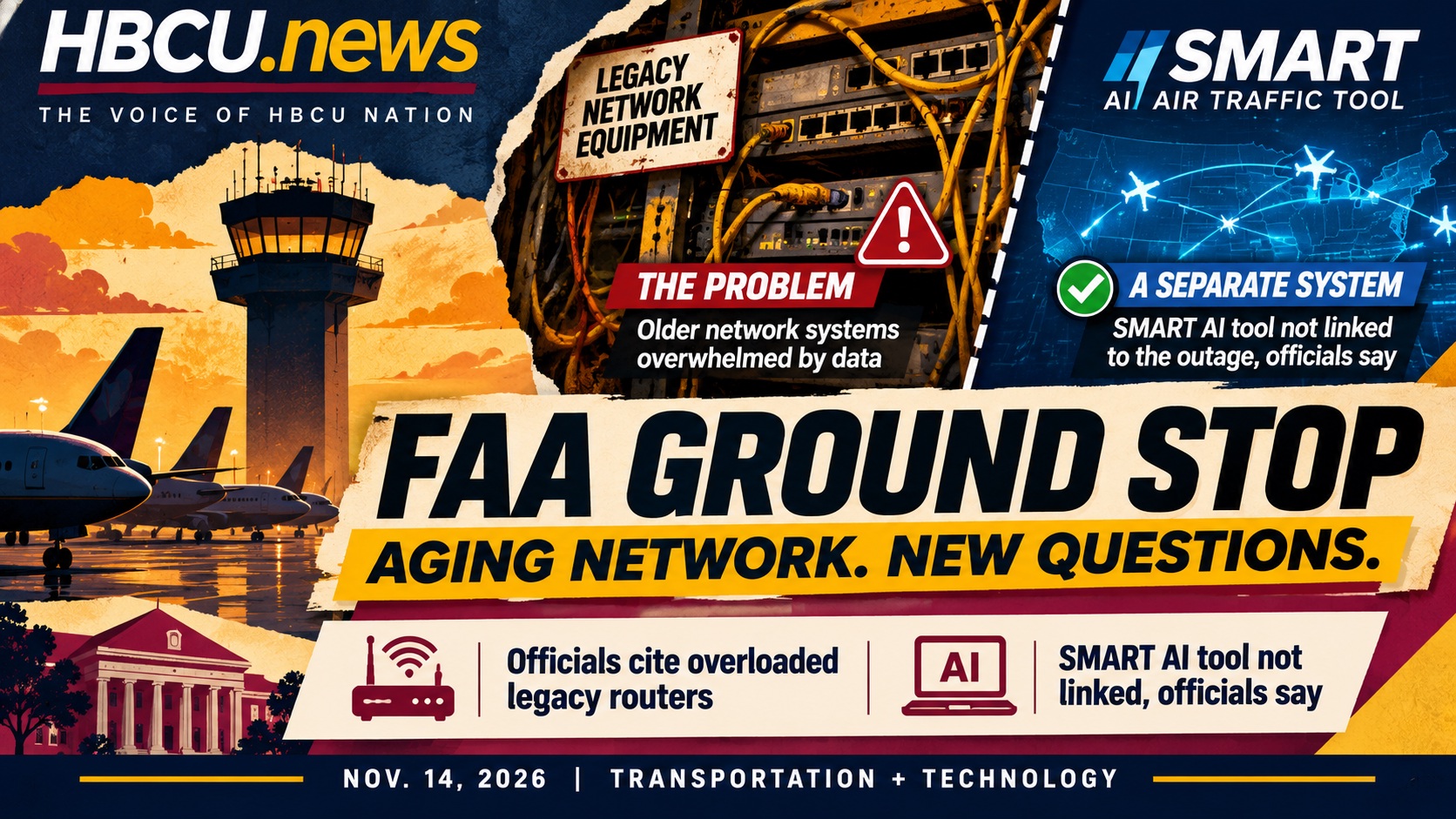
A nationwide ground stop halted flight departures across the United States on Friday, November 13, after trouble with air traffic control communications and radar data. The disruption came three days after the Federal Aviation Administration announced the expansion of an AI-assisted traffic management tool, drawing questions about whether the two events were connected.
Transportation Secretary Sean Duffy said overloaded switches and routers in the FAA's older telecommunications network produced inconsistent data. He said the newer SMART system was disconnected from the failed equipment. Reuters reported that what caused the overload itself had not yet been determined.
The distinction matters to anyone trying to understand the shutdown: officials have identified failing legacy equipment, but the public has not received a complete root-cause investigation. A coincidental technology rollout does not establish that the new software caused the problem.
The FAA issued the ground stop after communications problems affected multiple Air Route Traffic Control Centers. Duffy said the nation's airspace reopened at 8:15 p.m. Eastern, but warned flights would return gradually as airlines worked to reposition crews and aircraft.
The Associated Press reported that thousands of flights were disrupted, with college and professional sports teams among travelers caught in the disruption. The stop was a precaution taken as controllers faced unreliable information, rather than evidence that every aircraft in flight lost communications.
SMART, short for Strategic Management of Airspace, Routes and Trajectories, was announced for expansion to all 22 air traffic control centers on November 10. The FAA says the cloud-based tool combines 200 information streams, including weather and flight patterns, to help human specialists recommend scheduling and routing adjustments.
That timing prompted speculation about artificial intelligence. But Duffy said SMART was not physically connected to the legacy equipment that went down. AP also reported that Homeland Security Secretary Markwayne Mullin described new equipment as overwhelming the older system. Officials did not establish that the equipment Mullin discussed was SMART.
The broader technology problem has been documented for years. In September 2024, the Government Accountability Office reported that 51 of the FAA's 138 air traffic control systems were unsustainable, while 54 more were potentially unsustainable. Those findings describe infrastructure risk, not proof of the specific trigger on November 13.
A September 2026 GAO report raised another concern: the FAA's accelerated modernization program lacked a reliable overall cost estimate and integrated master schedule, potentially increasing the risk of delays or disruptions during upgrades.
For HBCU students and families, nationwide travel failures can complicate trips home, campus visits, conferences and athletics schedules. However, reporting reviewed for this article does not establish that a particular HBCU experienced a direct disruption. The more concrete campus connection is educational: engineering, technology, cybersecurity and journalism students can examine how legacy systems, AI claims and official investigations intersect.
Travelers should check flight status directly with their airline and preserve notices and receipts. Under federal refund rules, passengers may be entitled to a refund when a flight is canceled or significantly changed and they decline alternative travel or compensation. Separate expenses such as hotels may depend on airline policies.
The questions ahead are what overloaded the old network, how upgrades will avoid destabilizing remaining equipment, and when investigators will publish their findings. A new AI tool made an attention-grabbing timeline; the evidence available so far points to a much older infrastructure problem.
Why this matters: For HBCU students and families, nationwide travel failures can complicate trips home, campus visits, conferences and athletics schedules. However, reporting reviewed for this article does not establish that a particular HBCU experienced a direct disruption. The more concrete campus connection is educational: engineering, technology, cybersecurity and journalism students can examine how legacy systems, AI claims and official investigations intersect.