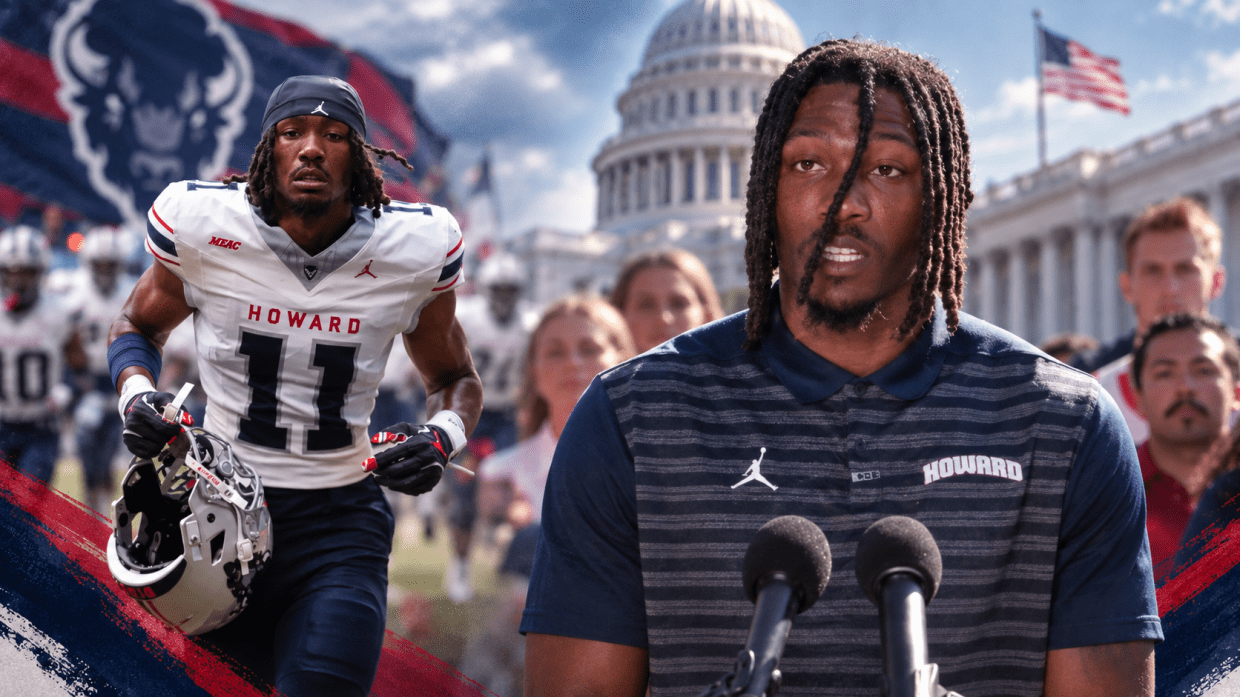
Howard University football player Kedrick Green is urging Congress to pass the Protect College Sports Act, placing an HBCU athlete at the center of a debate over legislation affecting college sports.
Green’s appeal comes as HBCU conferences support the legislation. At the same time, the Congressional Black Caucus and athlete-rights advocates oppose the act, creating a divide among groups connected to college athletics and public policy.
The competing positions make the legislation a point of significance for HBCU sports. Green’s support represents one athlete’s public call for Congress to move forward, while the opposition from the Congressional Black Caucus and athlete-rights advocates signals disagreement over the measure.
The summary does not provide details about the provisions of the Protect College Sports Act, the specific HBCU conferences supporting it, or the reasons given by the groups opposing it. It also does not indicate whether Congress has scheduled action on the legislation.
That limited information leaves the central question focused on whether Congress will pass the act and how the competing positions will shape the discussion. Green’s role as a Howard football player gives the debate a direct connection to an HBCU athletic program, while the broader disagreement places HBCU conferences alongside one position and the Congressional Black Caucus and athlete-rights advocates on the other.
For HBCU communities, the issue is not only a congressional matter but also one involving the voices associated with college sports. Green’s call adds an athlete’s perspective to the public conversation, while the opposing positions show that support for the legislation is not shared across all groups identified in the summary.
Watch for further discussion of the Protect College Sports Act as Congress considers the legislation and as the positions of HBCU conferences, the Congressional Black Caucus and athlete-rights advocates remain part of the debate.
Why this matters: The legislation has drawn a public position from a Howard University athlete and support from HBCU conferences, while the Congressional Black Caucus and athlete-rights advocates oppose it. That divide makes the act relevant to HBCU athletes, athletic programs and communities following the future of college sports.