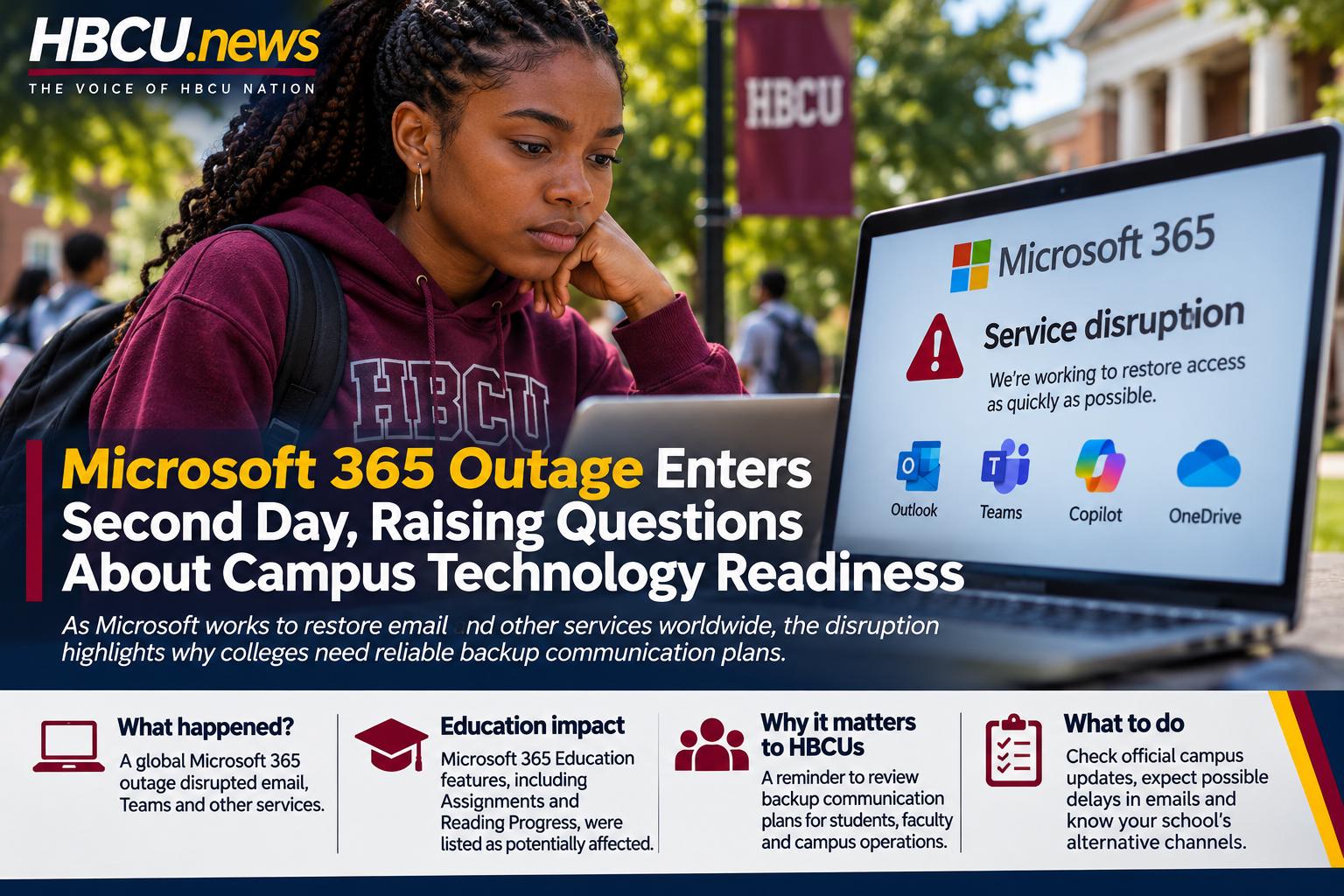
A Microsoft 365 outage that disrupted businesses, government agencies and digital communications worldwide entered its second day Friday, November 13, with the company reporting progress but warning that some users could continue experiencing intermittent problems.
The disruption affected Outlook email, Microsoft Teams, Copilot and other connected services, according to the Associated Press and Reuters. Microsoft reported improving service availability, although recovery was not yet complete.
For colleges and universities that rely on cloud-based technology, the outage raises an important question: What happens when the systems students and faculty depend on suddenly become unavailable?
The problems began Thursday, November 12, as users reported difficulties accessing email accounts and connecting to Microsoft applications. Reuters reported that Downdetector registered 138,058 reports of Outlook problems around the peak of the disruption. Those reports are submissions to an outage tracker, not a confirmed count of affected people.
The consequences extended beyond ordinary workplace inconvenience. The Associated Press reported interruptions to government email systems and public services, including a Manchester court proceeding and online police reporting in Britain. Organizations in multiple countries sought other ways to communicate.
Microsoft linked the disruption to problems with infrastructure supporting Exchange Online and connected services. The company said it had no indication of malicious activity. A definitive root cause had not been released as recovery continued Friday morning.
Microsoft's incident notices, reproduced by the University of Pennsylvania from its Microsoft 365 administrative console on November 13, listed Microsoft 365 Education among services that could be affected. Features including Assignments, Reading Progress and Speaker Progress were specifically identified as potentially impacted.
That documentation establishes a direct connection to educational technology. It does not, however, establish that any particular historically Black college or university experienced an outage.
For HBCUs and other institutions, the episode is a timely reminder to review campus communication plans. Email often carries financial-aid correspondence, faculty announcements, scholarship notifications and student-services updates. A disruption can make these routine but important exchanges harder to complete.
A student waiting for internship information may need another way to confirm a deadline. A faculty member may need a backup channel for urgent class updates. These are plausible risks to prepare for, not reported instances of harm at specific HBCUs during this incident.
Students encountering disruptions should consult official campus announcements, verify urgent information through established alternatives and allow for possible delays in email delivery. Campus technology administrators can check Microsoft's service-health notices and review what systems remain operational if their primary email platform fails.
For students studying information technology, cybersecurity and communications, the outage also provides a real-world case study in cloud infrastructure, incident response and institutional resilience.
The immediate priority is restoring reliable access. The longer-term lesson is making sure essential college operations can continue when a major technology provider encounters problems. Technology makes modern education possible; preparation keeps it moving when technology fails.
Why this matters: For colleges and universities that rely on cloud-based technology, the outage raises an important question: What happens when the systems students and faculty depend on suddenly become unavailable?