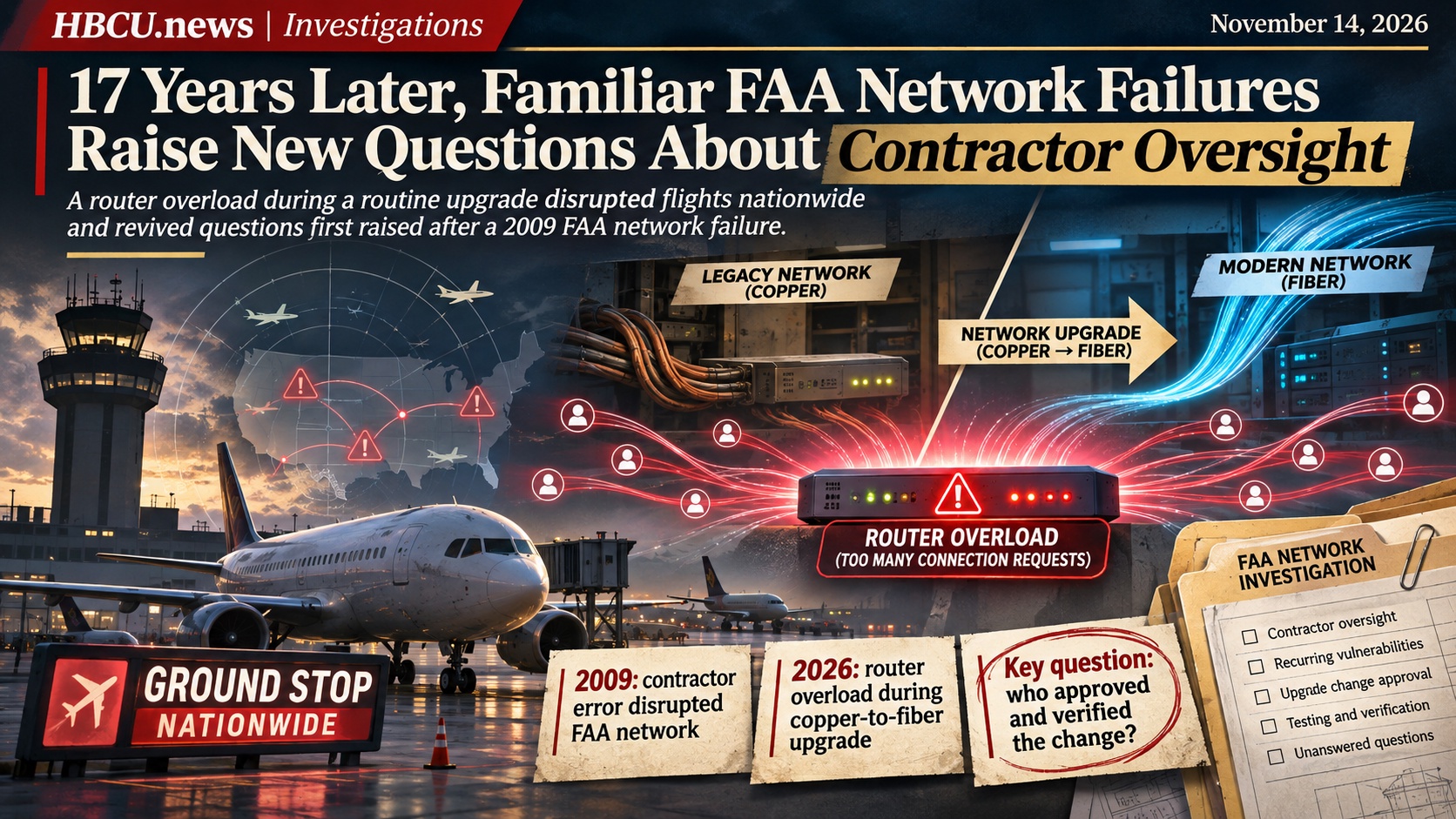
Nearly 17 years before a telecommunications failure brought departing flights across the United States to a halt on November 13, 2026, federal investigators examined a remarkably similar problem involving the same aviation network contractor.
In November 2009, maintenance errors by Harris Corporation disrupted the Federal Aviation Administration's telecommunications network, blocking flight-plan data and delaying hundreds of flights. Investigators eventually traced the breakdown to faulty router configurations, inadequate verification procedures and monitoring failures.
Today, that contractor's successor, L3Harris Technologies, is again involved in a nationwide aviation investigation.
The incidents are not identical, and responsibility for the latest outage remains undetermined. But the historical record raises a consequential question: Were the safeguards introduced after the earlier failure still protecting the nation's air traffic network when another routine upgrade went wrong?
A Warning From 2009
On November 19, 2009, Harris Corporation technicians were performing maintenance on the FAA Telecommunications Infrastructure network as the agency transitioned from older systems to a fiber-optic backbone.
An incorrect routing configuration, introduced during earlier maintenance, became active when a router was restarted. Data began traveling through unintended network paths, creating congestion that blocked approximately 75% of network traffic.
According to a June 17, 2010, Department of Transportation inspector general investigation, the disruption delayed service restoration for roughly five hours. The FAA's independent review reported that more than 800 flights were delayed.
The technical failure was serious. But investigators discovered something equally troubling about the network's defenses.
Harris had configured monitoring equipment to issue warnings when routers exceeded certain utilization levels. To suppress recurring alerts from one problematic router, technicians changed the monitoring configuration. The adjustment inadvertently disabled those alerts across the entire network.
As a result, the automated warning system that should have helped identify the congestion was not functioning as intended.
Federal investigators concluded that contractor maintenance errors caused the disruption and that FAA oversight could have been more proactive. The agency's independent review recommended automated configuration checks, stronger maintenance procedures, improved network monitoring, pre-deployment testing and evaluations of technical staffing.
FAA officials accepted the recommendations and reported corrective action. The record examined for this article does not yet establish how those protections were maintained or tested over the following 17 years.
Harris Corporation merged with L3 Technologies in 2019, forming L3Harris Technologies.
The contractor relationship continued.
A Familiar Problem Returns
On November 14, 2026, Transportation Secretary Sean Duffy said L3Harris technicians had been replacing aging copper telecommunications connections with fiber-optic infrastructure at a remote FAA facility when problems developed.
According to Duffy, a router began sending more than 1,000 connection attempts to other network routers every four to five seconds. The resulting traffic overwhelmed equipment supporting communications and radar-data services.
In plain English, the network was being flooded with connection requests faster than portions of its infrastructure could handle. The problem spread beyond the equipment undergoing maintenance, interfering with information that air traffic controllers needed to manage flights.
That resemblance to 2009 is notable: in both cases, maintenance involving network routing equipment triggered disruptions beyond the immediate work site.
But there is an essential distinction. Investigators established the faulty routing configuration responsible for the 2009 outage. They have not yet determined whether the November 2026 overload resulted from an installation mistake, defective equipment or another technical problem. The excessive connection attempts alone do not prove a routing loop or any particular configuration error.
The FAA ordered the nationwide ground stop as a precaution. Officials subsequently isolated the disruption and restored airspace operations, although airline schedules remained affected.
L3Harris acknowledged its role in the copper-to-fiber conversion, reporting that more than 70% of the planned work had been completed. The company said it was cooperating with investigators and did not publicly accept responsibility for causing the shutdown.
Who Was Watching the Network?
The FAA's relationship with L3Harris extends beyond individual maintenance projects.
Under its longstanding telecommunications arrangement, the contractor supports the legacy network's operation, maintenance, integration and monitoring. These functions are essential to keeping air traffic control communications available while older equipment is gradually replaced.
The federal government is also pursuing a separate modernization effort. In December 2025, the FAA selected Peraton to coordinate major replacement programs under its Brand New Air Traffic Control System initiative. AT&T was subsequently selected for work on the next-generation telecommunications network.
FAA Administrator Bryan Bedford made an important distinction during the November 14 briefing: the maintenance activity associated with Friday's shutdown was part of sustaining the existing network, not the Peraton-led modernization initiative funded through the $12.5 billion congressional appropriation.
That distinction narrows the immediate investigation.
The public records reviewed for this article do not identify which FAA officials approved the November 13 work, whether an independent technical review occurred, what rollback procedures were required or how the network change was monitored.
Those are not abstract administrative questions. They are precisely the kinds of safeguards federal investigators emphasized after the 2009 failure.
The Workforce Question
The oversight issue unfolds against significant changes to the FAA's federal workforce.
In February 2025, the Trump administration dismissed 352 FAA probationary employees. Transportation Secretary Duffy maintained that air traffic controllers and critical safety personnel were not among those dismissed, while employee unions challenged the characterization of the affected technical and support positions.
The Professional Aviation Safety Specialists union subsequently announced that 132 represented employees would be reinstated following a federal court order.
Government Accountability Office data show that 5,084 employees separated from the FAA during 2025 through retirements, resignations, terminations, transfers and other departures. The agency's net workforce declined by 1,605 employees between December 2024 and December 2025.
Those separations were not all firings, and the available records do not identify how many telecommunications technicians or contractor-oversight specialists permanently departed.
A September 2026 Department of Transportation inspector general audit revealed a separate workforce-planning problem. It found that 10,808 existing FAA employees designated Mission Critical or Public Safety were missing from published workforce plans.
The employees themselves were not missing. Their positions had not been adequately represented in the planning documents used to assess essential staffing needs.
The audit also identified inconsistent definitions of safety-critical occupations and insufficient information about employee competencies and senior-level staffing gaps.
No evidence reviewed for this article establishes that the 2025 dismissals contributed to the November 13 outage. Determining whether workforce changes affected network maintenance or contractor supervision would require more specific staffing and assignment records.
Still, the findings establish a legitimate oversight question: How does the FAA verify that it has enough qualified personnel to supervise critical infrastructure work when its published workforce plans do not fully account for every essential occupation?
The $50 Billion Question
The FAA's infrastructure problems began long before the current administration.
In September 2024, GAO found that 105 of the agency's 138 air traffic control systems were unsustainable or potentially unsustainable. Some replacement projects were expected to take another decade.
Congress appropriated $12.5 billion in July 2025 to accelerate modernization and support controller hiring.
Yet a September 2026 GAO investigation found that the newer modernization initiative lacked a comprehensive lifecycle cost estimate and an integrated master schedule. Instead, the FAA was managing 11,389 individual project schedules without fully coordinating their dependencies.
Auditors warned that projects could repeatedly require work at the same facilities without sufficient coordination to minimize operational disruptions.
Those findings concern the broader modernization initiative, not necessarily the legacy-network maintenance associated with Friday's outage. Nevertheless, they demonstrate the difficulty of rebuilding an interconnected national system while keeping it operational.
Following the shutdown, the administration raised its aviation infrastructure funding request to $50 billion, up from a $30.1 billion proposal announced earlier on November 13.
The request has not been enacted, and the public record does not establish that previously approved FAA funding was diverted to unrelated federal programs.
The financial questions are therefore more specific: How much of the existing appropriation has been obligated or spent? What additional work would the proposed funding cover? And what measurable safeguards will accompany the investment?
Why This Matters Beyond Aviation
For HBCU students, alumni and families, air transportation is a practical connection to campus visits, academic conferences, internships, athletic competition and travel home. No specific HBCU disruption has been independently established in the reporting reviewed for this article.
But the investigation also points toward the technical and public-service careers that keep national infrastructure functioning.
Students studying engineering, information technology, aviation, public administration and journalism are preparing to enter fields where decisions about maintenance, staffing and oversight have real consequences.
The lesson reaches beyond a single agency or administration: sophisticated systems are only as dependable as the people, procedures and institutional safeguards responsible for maintaining them.
What the Public Still Deserves to Know
The FAA must determine the precise technical cause of the November 13 outage and establish whether its contractor followed the required maintenance procedures.
It must also clarify who authorized the work, how risks were assessed, what monitoring systems detected, and whether the protections recommended after the 2009 failure remain effective today.
Those answers may reveal shortcomings in contractor execution, federal oversight or equipment reliability—or some combination of them. The evidence must establish which.
Seventeen years after federal investigators warned about network maintenance and monitoring failures, another upgrade has disrupted American aviation on a national scale.
Before Washington commits billions more to rebuilding air traffic control, the public deserves to know whether the safeguards protecting the system flying planes today actually work.
Why this matters: Students preparing for technology, aviation, communications, public administration and journalism careers can examine the documented safeguards, contractor oversight and public funding questions raised by failures of critical infrastructure.